
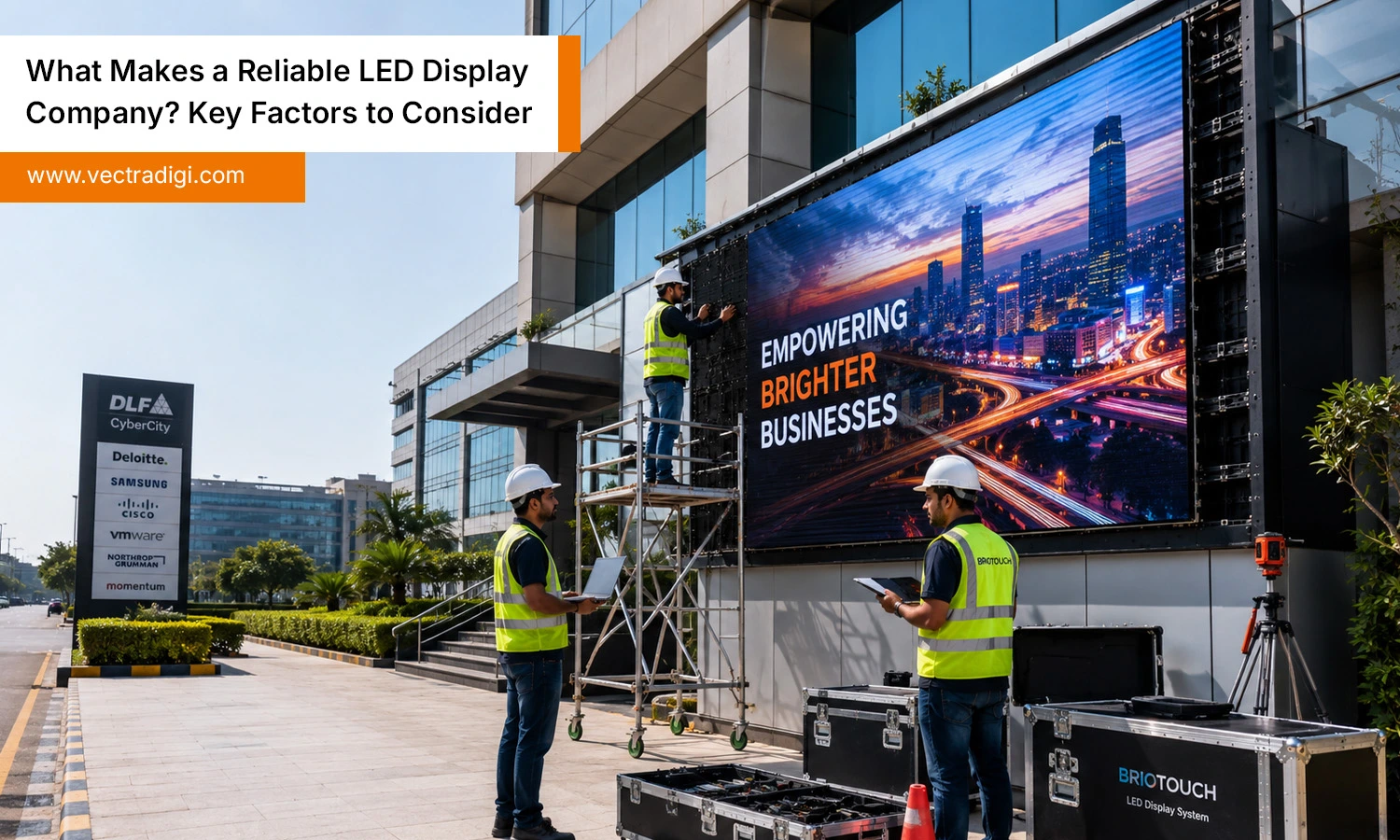
Selecting the right LED display company may seem straightforward at first, but the process becomes more challenging when different quotations, specifications, and options come into consideration. Two vendors can quote the same size screen at wildly different prices, and the gap usually comes down to pixel pitch, driver IC quality, panel binning, and — most overlooked — the strength of the installation and support team behind the product.
The global LED display market was valued at roughly USD 20.7 billion in 2026 and is projected to grow at a 5.41% CAGR through 2031, with fine-pixel-pitch panels (1.5mm and below) growing fastest as more corporate lobbies, control rooms, and broadcast studios adopt them, according to Mordor Intelligence’s 2026 LED Display Market report.¹ That growth has also pulled in a wave of resellers who private-label imported panels without engineering, installation, or service capability of their own. This guide breaks down exactly how to tell the two apart — what to check, what to ask, and what red flags mean walk away.
Table of Contents
- What Does an LED Display Company Actually Do?
- Why Choosing the Right Company Matters More Than Panel Specifications
- Key Factors to Consider in an LED Display Company
- Questions to Ask Before You Sign
- Common Mistakes That Cost Buyers Later
- How to Verify a Company’s Expertise (Not Just Trust Their Claims)
- Conclusion
- Frequently Asked Questions
Also Read: How LED Wall Display Boards Are Transforming Public Spaces
What Does an LED Display Company Actually Do?
An LED display company is a business that designs, supplies, installs, and supports LED video screens — indoor or outdoor, fixed or rental, standard-pitch or fine-pitch — for commercial, retail, corporate, sports, and event use. The strongest ones do more than sell hardware: they handle site surveys, structural and electrical planning, content-management software setup, calibration, and ongoing maintenance. A company that only ships panels and leaves installation and service to a third party is a reseller, not a full-service LED display company — and that distinction matters more than most buyers realize until something goes wrong six months in.
Why Choosing the Right Company Matters More Than Panel Specifications
Two screens built from identical panels can perform completely differently depending on who installed and calibrated them. An improperly fitted module can create uneven colors along panel joints. Weak outdoor mounting may lead to structural and safety concerns over time, while incorrect processor settings can cause noticeable delays in displayed content. The company is the variable that determines whether the spec sheet numbers actually show up on the wall.
Working with an established, accountable provider gets you:
- Display technology matched to your actual viewing distance and ambient light, not a one-size-fits-all recommendation
- Installation completed according to structural and electrical standards, followed by proper testing and verification before final handover.
- A single point of contact for warranty claims instead of chasing an overseas factory
- Software and firmware support as content-management platforms evolve
- A realistic total cost of ownership, not just a low sticker price that balloons in year two
Key Factors to Consider in an LED Display Company
1. Verifiable Industry Experience
The number of years a company has operated tells only part of the story. What matters more is the work and experience gained during that period. A company with a decade of experience installing retail digital signage may have zero experience with structural outdoor billboards or broadcast-grade fine-pitch walls. Request project references related to your application—such as indoor LED walls, outdoor billboards, sports perimeter displays, or rental and staging—and, if possible, speak with a previous client.
2. Key Product Quality Factors and Essential Technical Specifications
This is where most buying guides stay unclear. Here’s what to actually check:
- Pixel pitch (mm): the distance between LED clusters. Small pitch = high resolution at close range. As a rule of thumb, minimum comfortable viewing distance in meters ≈ pixel pitch (mm) × 1 to 3, depending on content type. A 1.5mm pitch wall in a boardroom needs a very different pitch than a 10mm outdoor billboard viewed from the street.
- Brightness (nits): indoor displays typically run 600–1,500 nits; outdoor displays need 4,000–8,000+ nits to stay visible in direct sunlight.
- Refresh rate (Hz): anything under ~1,920Hz can strobe or flicker on camera — critical for broadcast, sports, and any screen that will be filmed.
- IP Rating: Outdoor LED displays should generally have a minimum IP65 rating on the front and IP54 on the rear to provide reliable protection against dust and water. Indoor installations typically do not require this level of protection. If a supplier recommends an outdoor-rated display for an indoor environment—or the other way around—it may indicate that the solution is not being selected based on the actual application.
- Chip/packaging type: SMD, COB (Chip-on-Board), and GOB (Glue-on-Board) packaging trade off cost, durability, and bezel-free seamlessness differently — COB and GOB generally hold up better to impact and moisture.
- Panel binning/calibration: LEDs vary slightly in brightness and color even from the same factory batch; proper binning and on-site calibration is what prevents visible color blocks between panels.
A reliable company explains these specifications clearly instead of simply giving you a polished brochure.
3. Range of Display Solutions
Indoor fine-pitch, outdoor billboard-grade, transparent/glass-mount, rental and staging, curved and creative-shape displays each require different engineering. A company offering only one category will (understandably) try to fit your use case into what they sell — a wide catalog signals they can actually recommend based on your space, not their inventory.
4. Customization Capability
Size, shape, curvature, mounting method, and brightness should all be adjustable to the environment rather than the environment being adjusted to a standard SKU. This matters most for retail storefronts, branded lobbies, and architecturally unusual venues.
5. Installation and Technical Expertise
Confirm who handles the installation, whether it is the company’s own technical team or an external contractor. Also, check which quality and safety tests are completed before handover, such as extended display testing, color consistency checks, and structural stability assessments for outdoor installations. A vendor that can’t describe a testing process likely doesn’t have one.
6. After-Sales Support and Maintenance
An LED display requires ongoing support, not just installation. Check the supplier’s service response time, availability of remote troubleshooting, and whether replacement panels or modules are stocked locally or sourced internationally. Fast local support can mean repairs in days instead of weeks.
7. Customer Reviews and a Verifiable Portfolio
Look past the testimonials page on the vendor’s own site. Check third-party review platforms, ask for two or three references in your industry, and if possible, visit a completed installation in person or via video call.
8. Transparent Pricing and Warranty
Request a clear cost breakdown covering the LED panels, mounting structure, installation, control system, transportation, and warranty. This helps prevent unexpected charges or confusion about what the quoted price actually covers. Warranty terms of 2–3 years on panels and 1 year on labor are common in the industry — anything significantly shorter is worth questioning.
Questions to Ask Before You Sign
- What’s your experience with projects in my specific category (indoor/outdoor/rental/transparent)?
- Could you provide a reference from a previous client who worked on a similar type of project?
- What pixel pitch and brightness do you recommend for my viewing distance and ambient light, and why?
- Which LED packaging technology—SMD, COB, or GOB—is included in the quotation, and what are the advantages and limitations of each option?
- Is installation done in-house or subcontracted?
- Which inspections and performance checks are completed before final handover, and will the testing process and results be provided in writing?
- What’s the warranty period on panels vs. labor, and what voids it?
- What’s your guaranteed response time for a service ticket?
- Are spare parts stocked locally?
- Is the quote itemized, and does it include freight, structure, and control system?
- What certifications (UL, CE, RoHS, ISO) do the panels carry?
- What’s the expected lifespan (hours) at the brightness level you’re recommending?
- Can the display be expanded or upgraded later without full replacement?
- Who is my point of contact after installation is complete?
Common Mistakes That Cost Buyers Later
- Comparing quotes on price alone, without confirming pixel pitch, brightness, and chip type are actually equivalent between vendors
- Skipping the reference check and relying only on the vendor’s own case studies
- Not confirming who installs — a great panel poorly mounted is a liability, not an asset
- Ignoring warranty exclusions until a claim gets denied
- Buying brightness/pitch specs that don’t match the environment — over-speccing wastes budget, under-speccing makes the screen unreadable
How to Verify a Company’s Expertise (Not Just Trust Their Claims)
- Ask for photos or video of in-progress installations, not just finished renders — it shows real crews, not stock photography
- Request the manufacturer’s data sheet for the exact panel model quoted, and cross-check the nits/pitch/refresh numbers against what was verbally promised
- Verify certifications through official authorities or trusted databases to confirm their validity and authenticity independently.
- Ask how long the company has held its installation license/insurance, if your region requires one for structural signage work
Conclusion
Panel specifications alone cannot determine the right display choice. The company installing, calibrating, and supporting that panel for the next 5–10 years is the other half — and it’s the half most buyers under-research. Use the questions and checklist above before you sign anything, verify claims rather than taking them at face value, and prioritize itemized pricing and a real installation/service team over the lowest quote.
Ready to talk through your project? VectraDigi can walk through pixel pitch, brightness, and installation planning for your specific space — contact the team to get an itemized quote.
Frequently Asked Questions
Q1: How do I choose a reliable LED display company?
Ans: Check three things first: verifiable project experience in your specific display category, transparent itemized pricing with a clear warranty, and an in-house (not subcontracted) installation team. Then confirm the pixel pitch and brightness recommendation actually matches your viewing distance and lighting — a company that explains this unprompted is usually the more reliable one.
Q2: What is the difference between an LED display company and an LED display manufacturer?
Ans: A manufacturer produces the physical panels; an LED display company (sometimes the same business, sometimes a separate integrator) handles site assessment, custom sizing, installation, calibration, and after-sales support. Buying directly from a manufacturer with no local installation or service arm often means no one is accountable if something fails after handover.
Q3: How much does it cost to work with an LED display company?
Ans: Pricing depends on pixel pitch, indoor vs. outdoor rating, size, and installation complexity, but expect the panels themselves to be roughly 50–70% of total project cost, with structure, control systems, freight, and labor making up the rest. Request a detailed cost breakdown to compare suppliers fairly based on matching specifications, features, services, and overall project requirements.
Q4: What certifications should an LED display company’s products have?
Ans: Check for UL or CE safety certification, RoHS compliance, and suitable ingress protection, such as IP65 or IP54 ratings, when selecting outdoor LED display panels. ISO 9001 on the manufacturing side is a good additional signal of consistent quality control.
Q5: How long does an LED display installation take?
Ans: A standard indoor video wall typically takes 1–3 days once panels and structure are on-site; large outdoor billboards or structurally complex installs can take 1–2 weeks including electrical work and testing. Site survey, permitting, and lead time on custom panels usually add several weeks before installation even begins.
Q6: What warranty should I expect from an LED display company?
Ans: Industry-standard warranty coverage is typically 2–3 years on the LED panels and around 1 year on installation labor, though this varies by vendor and region. Always confirm in writing what voids the warranty (e.g., unauthorized repairs, environmental exposure outside the panel’s IP rating) before signing.
Q7: Can an LED display be repaired if a module fails?
Ans: Yes — quality LED walls are built from individually replaceable modules or panels, so a single failed section can usually be swapped without replacing the entire display. Ask your vendor whether they stock spare modules locally, since sourcing a replacement from overseas can mean weeks of downtime.
Q8: Is it better to buy from a local LED display company or an overseas manufacturer directly?
Ans: For most commercial buyers, a local or regional company with its own installation and service team is lower-risk than buying panels directly overseas, because warranty claims, spare parts, and troubleshooting all require someone accountable on the ground. Direct overseas purchasing can lower upfront cost but usually shifts installation and service risk entirely onto the buyer.

