Digital signage networks are growing quickly in places like retail stores, offices, schools, hospitals, and transport hubs, where businesses use screens to share information, promotions, and real-time updates. However, as the number of displays increases, managing them becomes difficult, especially when content needs to be updated across multiple locations. This is why a digital signage CMS is important, as it allows businesses to control all screens from one place and schedule content easily. Today, companies usually choose between traditional signage management and a cloud-based CMS for digital signage, and understanding the difference between these two systems helps in selecting the right solution for modern digital signage networks. In this blog, we will compare cloud-based CMS vs traditional signage management, explain their differences in simple language, and help you decide which system is best for modern digital signage networks.
Table of Contents
Also Read: Top 7 Reasons to Use a Digital Signage CMS for Business Growth
What Is Cloud-Based CMS for Digital Signage?
A cloud-based CMS for digital signage is a modern system where the software runs on the internet instead of a local server. This allows users to control all digital screens from anywhere using a computer, tablet, or mobile device. Content is stored in the cloud, so updates can be sent to multiple displays at the same time without manual work. It becomes easier to manage screens in different locations, such as schools, retail stores, hospitals, or offices. A cloud system also works as a remote signage management system, allowing scheduling, monitoring, and quick changes, which is why many businesses prefer it over traditional signage management.
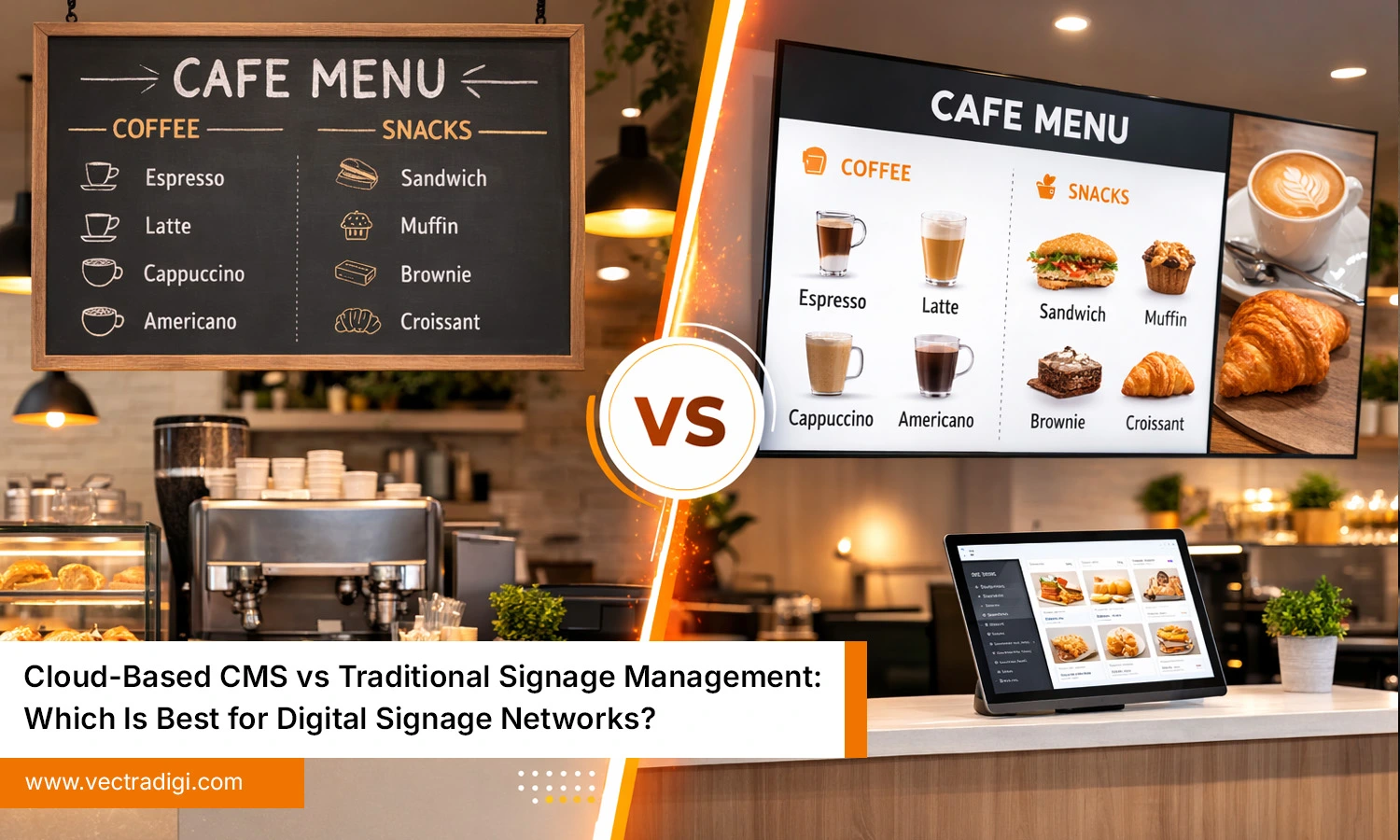
Cloud-Based CMS vs Traditional Signage Management
| Feature | Traditional Signage Management | Cloud-Based CMS for Digital Signage |
|---|---|---|
| Setup | Needs a local server and manual installation | Easy setup, no server needed |
| Access | Works on the local network only | Access from anywhere via the internet |
| Scalability | Hard to expand, needs a hardware upgrade | Easy to add more screens anytime |
| Maintenance | Requires IT support and server care | Automatic updates by the provider |
| Cost | Low start cost, high maintenance later | Subscription, but lower long-term cost |
| Security | Data stored locally | Secure cloud with encryption |
| Updates & Control | Slow manual updates | Instant remote updates |
| Best Use Case | Small or offline setups | Large modern signage networks |
Which Is Best for Modern Digital Signage Networks?
For most businesses today, a cloud-based CMS for digital signage is considered the better choice, especially when the network includes multiple screens or different locations. It allows users to control content remotely, make quick updates, and manage everything from a single dashboard without depending on local servers. This makes daily operation easier and reduces the need for constant technical support. As organizations grow, cloud platforms also make it simple to add more screens without changing the whole system.
Traditional signage management can still work for small setups where only a few displays are used, but it becomes harder to handle when the network expands. Modern businesses need flexibility, faster updates, and reliable performance, which cloud systems provide more easily. Because digital signage is now used in retail, education, healthcare, and corporate offices, many companies prefer cloud solutions for long-term use.
Why cloud CMS is preferred:
- Remote access from anywhere.
- Easy to scale network.
- Lower maintenance effort.
- Faster content updates.
- Better for multi-location setups.
When Traditional Signage Management May Still Be Useful
Even though cloud systems are widely used today, traditional signage management can still be suitable in some situations. Small offices with only a few screens may not need a cloud-based CMS, as a local server can handle simple content without extra cost. Places with limited or unstable internet connections may also prefer on-premise systems because they work without depending on the cloud. In high-security environments, organizations sometimes avoid cloud platforms to keep full control over their data. Businesses that already have server infrastructure may also choose traditional signage management to reduce additional expenses and keep the setup simple.
Benefits of Cloud-Based CMS for Large Digital Signage Networks
- Centralized control: With a cloud-based CMS for digital signage, everything can be handled from one place. Instead of updating every screen one by one, you just log in and manage the whole network together, which saves a lot of time when there are many displays.
- Real-time updates: One thing businesses really like about cloud systems is how quickly changes can be made. If you need to update an offer or show an announcement, you can do it instantly on all screens without waiting or visiting each location.
- Less hardware dependency: Traditional signage setups often depend on local servers, and that can make things complicated. Cloud software keeps most of the work online, so there’s less hardware to worry about and fewer chances of technical trouble.
- Better reliability: Because cloud platforms run on maintained servers, updates and backups usually happen automatically. In real use, this means the signage network keeps running smoothly and doesn’t stop as often as older systems.
- Easy multi-location management: When screens are installed in different branches or cities, managing them manually becomes difficult. Cloud CMS makes this easier because you can control everything remotely without being physically there.
- Ideal for large networks: As the number of screens grows, traditional systems start feeling limited. Cloud platforms are designed for bigger networks, so they handle more displays without making the process complicated.
- Future-ready solution: Most businesses now prefer cloud systems because they are easier to expand later. You can add more screens anytime without changing the whole setup, which makes the system more practical for long-term use.
Conclusion
To sum it up, both traditional signage management and cloud-based CMS have their place, but the better option really depends on how large and active your digital signage network is. If you only have a few screens, a local system may still work fine. But once the network starts growing, managing everything manually becomes time-consuming. That’s where a cloud-based CMS makes life easier, because you can control screens remotely, update content quickly, and expand without changing the whole setup. As more businesses move toward connected systems, cloud signage platforms are slowly becoming the more practical choice for long-term use.
Looking to upgrade your digital signage setup? Vectradigi offers modern cloud-based CMS, LED displays, and complete signage solutions that make managing multiple screens easier, faster, and more reliable for growing businesses.