
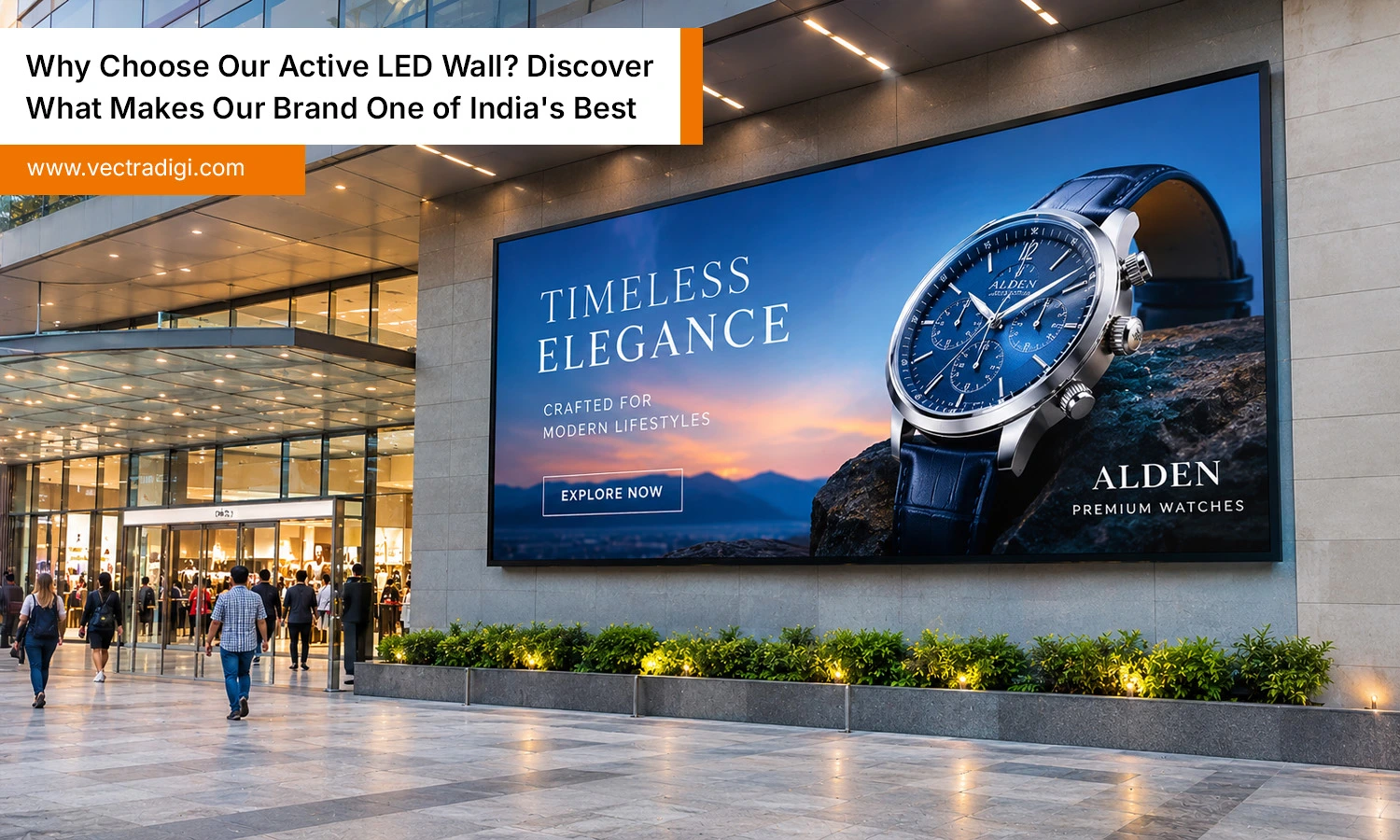
Picking a display for a hospital lobby, a bank front or a school hall is a long-term decision. The screen will run for years, often for many hours every single day. That is why the brand behind your active LED wall matters as much as the panel. Specifications often look similar on paper. Real differences show up in brightness control, build quality and service response. In this guide, we explain what sets our Active LED Display apart. We also share the checks we suggest for any buyer. That way, you can compare brands with clarity, not just on price alone.
Also Read: How to Choose the Best LED Wall Brand for Your Business
What Is an Active LED Wall?
An active LED wall is a large display assembled from multiple LED modules. Each tiny diode emits its own light. There is no backlight, unlike an LCD screen.
Modules fit into cabinets. Cabinets join together to form one seamless LED video wall. A controller syncs content across every panel, so the image looks like one picture.
Its modular structure allows displays to be customised to almost any size. Individual modules can be replaced when needed, eliminating the need to change the entire display.
What Makes Our Active LED Wall Different
A Pixel Pitch for Every Viewing Distance
Pixel pitch refers to the millimetre distance separating neighbouring LED pixels across a display. A smaller pitch means a sharper image up close.
We offer these configurations:
- Indoor LED displays : come in P1.2, P1.5, P1.8, P2, P2.5, P3, and P4 pixel pitches.
- Outdoor LED display: P2.5, P3, P4, P6, P8 and P10
A common rule of thumb helps here. The minimum comfortable viewing distance in metres is roughly the pitch number. So a P2.5 screen suits viewers about 2.5 metres away or more. A P10 billboard works best when people view it from across a road.
Choosing a finer pitch than you need only raises the cost. Our team matches pitch to your actual room or site.
Brightness That Suits the Setting
Our indoor panels reach up to 1,000 nits. Outdoor models go up to 6,000 nits, so content stays readable in direct sunlight.
More brightness is not always better indoors. An overly bright screen in a boardroom causes eye strain. That’s why the colour temperature is adjustable from 1000K to 9500K. You can tune the screen to warm or cool lighting.
Smooth Visuals, Even on Camera
Refresh rates go up to 3,840Hz. This keeps video smooth and flicker-free. It also matters when events are filmed or streamed, because low refresh rates show lines on camera.
A 160° horizontal and vertical viewing angle keeps colours consistent from the sides. The zero-bezel design removes visible gaps between panels.
Built for Indian Weather and Long Hours
Outdoor units carry an IP65 rating. That means protection against dust and water jets, which suits monsoon rain and dusty roadsides.
Cabinets come in mild steel sheet and die-cast options. The display offers a rated operating lifespan of up to 100,000 hours. Real life depends on usage, heat and maintenance.
Typical power consumption varies between approximately 130W and 300W per square metre. The exact figure depends on pitch and brightness settings.
Indoor or Outdoor: Choosing the Right Build
Indoor LED display panels are lighter and slimmer. They suit malls, auditoriums, classrooms and control rooms. Their lower brightness keeps them comfortable for close viewers.
Outdoor LED display units need sealed, weatherproof cabinets and far higher brightness. They suit shop fronts, highways, stadiums and campus gates.
Semi-outdoor spots need extra care. A glass storefront facing the sun may need more brightness than a typical indoor screen. Share details like sun direction and mounting height during the site survey. That one detail often decides the right model.
Custom Shapes and Simple Content Control
Not every space needs a flat rectangle. We can build spheres, cubes and cylindrical displays for malls, museums and brand activations.
Every screen pairs with our Digital Signage CMS. You can schedule playlists, push live updates and manage several screens from one dashboard.
Experience You Can Verify
Claims are easy to make. Track records are harder to fake. Here is what our numbers look like today:
- 8+ years of OEM industry experience
- 1,000+ LED screens installed
- 700+ projects delivered
- 800+ cities served across India
We are GeM certified and ISO compliant. This matters for government buyers who must follow public procurement rules. Our clients include hospitals, defence units, schools, banks and retail brands. Our Google rating currently stands at 4.9 stars. Even so, we suggest seeing a live installation before you decide.
A few recent installations show the range. We installed an 80ft x 8ft indoor LED display at Safdarjung Hospital, New Delhi. We set up a P2.5 indoor screen at a government school in Dumka, Jharkhand. We also built a 20ft x 4ft P4 outdoor display for Punjab & Sind Bank in Hyderabad.
Support That Continues After Installation
An LED display requires ongoing investment beyond its initial purchase price. It needs calibration, cleaning and occasional repairs.
Our standard warranty is one year. You can extend it up to three years. We offer technical support, regular maintenance, fault diagnosis, and repair services.
We service screens that need fixing too. At NDRI, Karnal, our team solved a mapping problem on a P2.5 indoor display and restored a clean image.
How to Compare LED Display Brands in India
Whichever LED display manufacturer in India you shortlist, these checks will protect your budget:
- Ask for the full datasheet. Check pitch, brightness, refresh rate and IP rating.
- See a live screen. View it in daylight if you plan an outdoor install.
- Match pitch to distance. Do not pay for resolutions nobody will notice.
- Get warranty terms in writing. Note what is covered and for how long.
- Confirm local service. Ask how quickly a technician can reach your site.
- Check content software. Remote control saves time across multiple screens.
- Verify GeM listing. This matters significantly for government and PSU tender applications.
Conclusion
A good active LED wall should look sharp, survive its setting and stay supported for years. Our displays cover indoor and outdoor needs with pitches from P1.2 to P10. They offer up to 6,000 nits outdoors, a 3,840Hz refresh rate and IP65 protection. Behind the hardware is real experience across hundreds of projects and a support team that keeps screens running. Still, the right choice depends on your space, audience and overall budget. Use the checklist above to compare any brand fairly. When you are ready, our team would be glad to help you plan a display that truly fits.
Planning an LED Wall Project? Tell us your space size, viewing distance and purpose. Contact our team they will suggest a suitable pitch and give you a clear quote.
Frequently Asked Questions
Q1. What is the price of an active LED wall in India?
Ans: Price depends on pixel pitch, screen size, indoor or outdoor use and installation work. A finer pitch costs more per square foot. Share your size and site details with us for an accurate quote.
Q2. Which pixel pitch should I choose?
Ans: Base it on viewing distance. P1.2 to P2 suits close indoor viewing, such as boardrooms. P6 to P10 suits outdoor screens viewed from far away.
Q3. How long does an active LED wall last?
Ans: Our panels are rated for up to 100,000 operating hours. Actual life depends on daily usage, ventilation and regular maintenance.
Q4. What warranty do you offer on your Active LED Display?
Ans: Our product includes a standard one-year warranty across India. You can extend coverage up to three years for added protection.

