
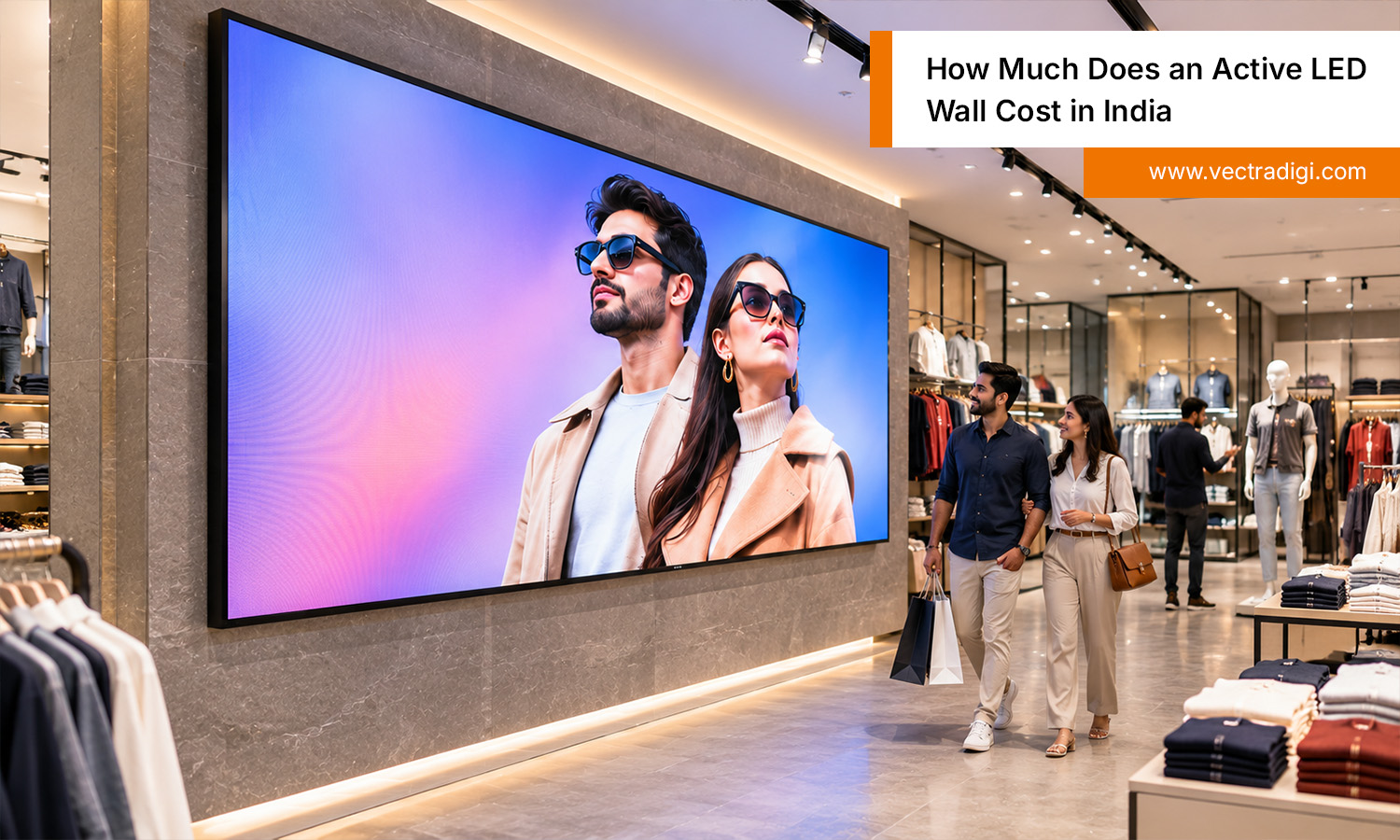
Walk into any modern showroom, airport lounge or corporate lobby today and you will probably notice a bright, seamless screen covering an entire wall. That is an active LED wall, and more Indian businesses are now asking what it really costs to install one. The honest answer is that it depends. Pixel pitch, screen size, indoor or outdoor use, installation and after-sales support all shape the final bill. In this guide, we break down the pricing of an active LED wall display in India, explain what pushes the cost up or down, and share practical tips to help you budget wisely.
Also Read: How to Maintain an LED Display Screen for Better Performance and Longer Lifespan
Active LED Wall Price in India: A Quick Overview
In India, LED walls are usually priced per square foot, and the rate changes mainly with pixel pitch and whether the screen is meant for indoor or outdoor use. Instead of one fixed number, it is better to think of the cost as a range. An entry-level good quality active LED wall for a business or a small reception area starts from around ₹4,800 per sq.ft., while large outdoor billboards, fine pitch boardroom walls and custom-shaped stage screens can go up to several crores, depending on the specifications.
As a general pattern, fine pitch indoor screens cost the most per square foot, standard indoor screens sit in the middle, and outdoor screens with larger pixel pitches usually cost less per square foot. However, the final quote always depends on the size, component quality, installation work and support package you choose, which is exactly what the next section explains.
Key Factors That Affect the Cost
1. Pixel Pitch
Pixel pitch indicates the millimetre spacing between two neighbouring pixels on an LED display. A smaller pitch packs more pixels into the same area, giving sharper images for close viewing. It also means more LEDs and more processing power, so the price climbs quickly. As a general guideline, comfortable viewing distance in metres approximately matches the pixel pitch value measured in millimetres.
2. Screen Size
A bigger wall needs more modules, cabinets, power supplies and receiving cards. The total cost rises with every square foot, although some suppliers offer a slightly lower per sq. ft. rate on large orders.
3. Indoor vs Outdoor Use
Outdoor screens must survive heat, dust and heavy monsoon rain. They need IP65-rated cabinets, much higher brightness (often 5,000 nits or more compared with 600 to 1,000 nits indoors) and sturdier mounting structures. These requirements add to the overall project cost.
4. LED Type and Component Quality
SMD and COB remain the two widely used LED display technologies. COB panels are tougher and better suited to fine pitch screens, but they cost more. The quality of LED chips, driver ICs and power supplies also matters. A higher refresh rate, for instance, prevents flicker when the screen is filmed on camera.
5. Controller and Software
Every active LED wall display needs a control system: sending cards, receiving cards, a video processor and content management software. Screens that play content from a USB or the cloud without a connected PC need asynchronous controllers, which cost a little more but are easier to manage.
6. Installation and Structure
Wall mounting, floor stands, steel frames, electrical cabling and labour usually add 10 to 20 percent to the screen price. Complex sites, such as building facades or curved walls, can push this higher.
7. Warranty and After-Sales Support
A cheaper quote with a short warranty and no local service team can end up costing more in the long run. Check what the warranty covers, how fast repairs happen and whether spare modules are included.
Hidden Costs You Should Not Ignore
When planning your budget for an active LED wall display, look beyond the per sq. ft. rate and keep these extra costs in mind:
- Electricity: Large and outdoor screens draw significant power, especially at high brightness.
- Spare modules: Keeping 2 to 5 percent extra modules ensures colour-matched replacements later.
- Annual maintenance contract: Regular cleaning and checks extend the life of the screen.
- Taxes: Always confirm whether a quote includes GST.
- Content creation: Videos and graphics sized for your screen resolution may need a designer.
Tips to Get the Best Value
- Select pixel pitch according to actual viewing distance rather than automatically choosing the highest available resolution.
- Ask for a live demo and see the screen in person before you sign.
- Compare the total cost of ownership, not just the per sq. ft. price.
- Get brightness, refresh rate and warranty terms in writing.
- Prefer a supplier with a local service team who can respond quickly.
Is an Active LED Wall Display Worth the Investment?
For most businesses, yes. A good LED wall lasts for many years and replaces the recurring cost of printed banners and posters. You can update content instantly, run promotions, show live feeds and grab attention in a way that static signage simply cannot. Retail stores, corporate offices, hotels, educational institutions and event companies often see a clear return through better footfall, engagement and brand recall.
Conclusion
Active LED wall pricing across India varies according to your specific requirements, intended application, and display configuration. A small indoor screen for a shop counter costs far less than a giant outdoor billboard, and the right pixel pitch, quality components and dependable service make a big difference over time. Compare specifications carefully rather than chasing the cheapest quote. If you are looking for a reliable active LED wall display at a better price, Vectradigi Technologies offers solutions for retail, corporate, events and outdoor advertising, along with installation and after-sales support. An active LED wall of a good quality starts from around ₹4,800 per sq. ft., making it accessible to businesses of almost every size.
Ready to upgrade? Contact us & get your active LED wall from Vectradigi Technologies at the best price.
Frequently Asked Questions
Q1. What is the starting investment required to install a small active LED wall?
Ans: A compact indoor screen of around six to eight square feet can be set up within a modest budget. Overall pricing varies with pixel pitch, controller, mounting structure, and installation expenses.
Q2. Which pixel pitch should I choose for my office reception area?
Ans: For reception areas where people stand two to three metres away, P2 to P2.5 works well. It gives sharp visuals for logos and videos without pushing your budget too high.
Q3. How long does an active LED wall display usually last in India?
Ans: Properly maintained LED walls generally offer 80,000–100,000 hours of operation. With proper ventilation, stable power supply and regular cleaning, most businesses use their screens comfortably for eight to ten years.
Q4. Are outdoor LED displays generally more expensive than indoor display systems?
Ans: Per square foot, outdoor walls often cost less because they use larger pixel pitches. However, waterproof cabinets, higher brightness, steel structures and weatherproof wiring can raise the overall project cost.

