
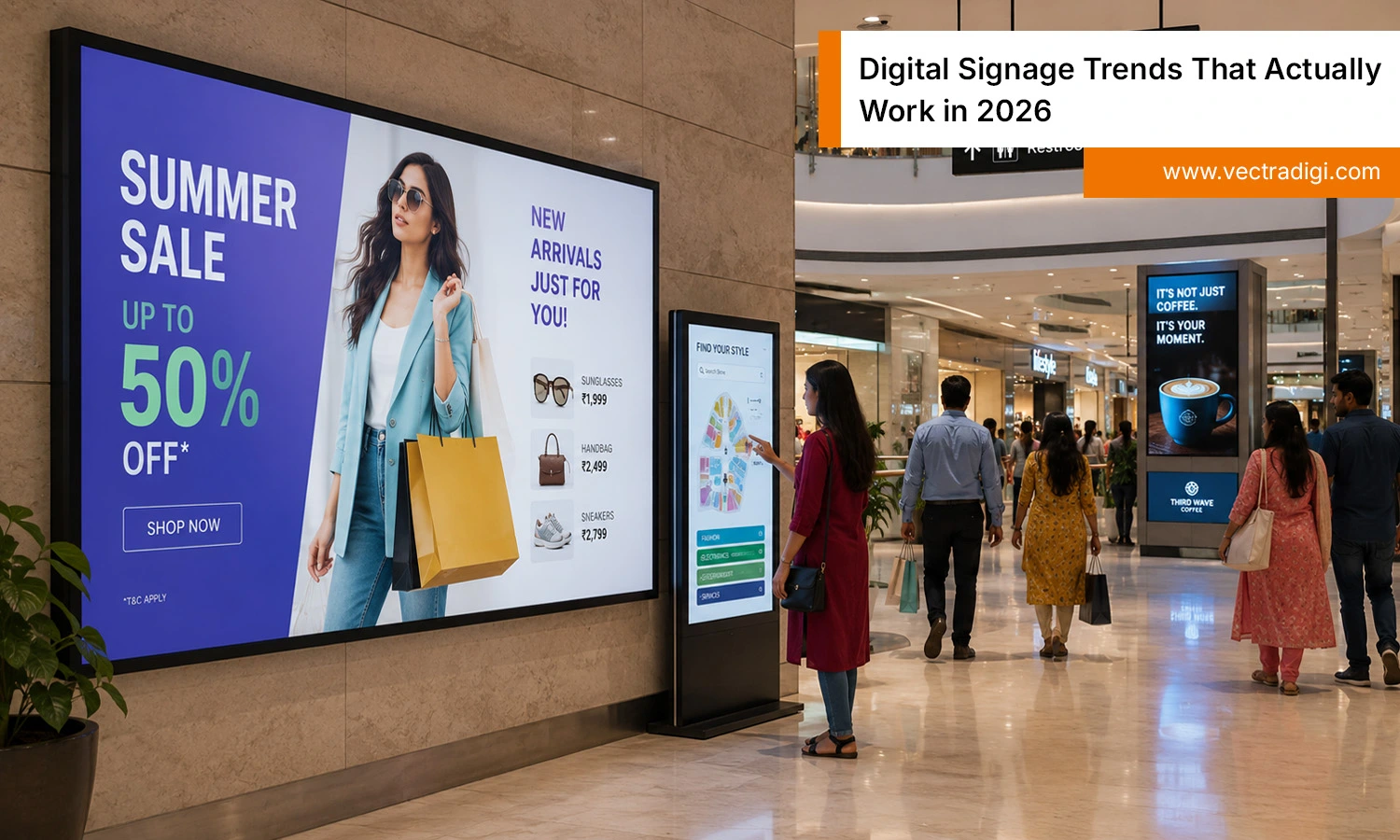
Walk into almost any store, airport, or restaurant these days and you’ll spot a screen somewhere. That’s not new, what’s new is what’s actually happening on that screen. A few years back, digital signage meant a slideshow of promotions looping on repeat, easy to ignore and easier to forget. In 2026, that’s changed. The screens are smarter, the content is timelier, and the businesses using them well are seeing real results. But not every “trend” you read about online is worth your budget. Some genuinely reshape how businesses connect with customers. Others are just hype. This guide cuts through the noise and shows you what’s actually working right now.
Table of Contents
Also Read: Common Digital Signage Mistakes to Avoid
Why Digital Signage Trends Actually Matter in 2026
A decade ago, digital signage was a “nice to have.” Today, it’s closer to a necessity for any business that relies on foot traffic, whether that’s a retail chain, a clinic waiting room, or a corporate office lobby. Why the shift? Mostly because customer attention has become harder to earn. People are used to personalized apps, on-demand content, and instant information. A static screen showing the same graphic for six hours straight just doesn’t hold anyone’s focus anymore.
There’s also a cost angle. Printed signage needs reprinting every time something changes, which adds up fast if you’re running seasonal promotions or updating prices often. Digital signage removes that friction entirely. You update it once, and it’s live everywhere, instantly.
The businesses getting the most value out of signage in 2026 aren’t necessarily spending the most money. They’re the ones matching the right technology to the right problem. That’s really what this whole trend of conversation comes down to.
The Digital Signage Trends Actually Worth Your Attention
1. AI-Powered Personalization
This is probably the biggest shift in how digital signage behaves. Instead of showing the same content to everyone, AI-powered signage now adjusts based on real-time factors like time of day, weather conditions, or even general foot traffic patterns picked up by in-store sensors.
Picture a coffee shop that automatically switches its screen from hot lattes to iced drinks the moment the temperature climbs past a certain point outside. Or a clothing store that highlights rain jackets when the forecast shifts. That kind of relevance used to require someone manually swapping content throughout the day. Now it happens on its own.
Worth noting: some AI signage setups use cameras to estimate age range or gender for more targeted content. If you’re considering this route, be upfront with customers about what data is being used and how, since privacy expectations around in-store sensors are only getting stricter.
2. Interactive Touchscreen Displays
Interactive signage has moved well past the awkward “touch to learn more” kiosks of the past. In 2026, these displays will be genuinely useful. Think self-service ordering at a restaurant, wayfinding maps at a mall, or product comparison tools in an electronics store.
The appeal here is twofold. Customers get to explore at their own pace without waiting for a staff member, and businesses reduce pressure on their teams during busy periods. A retail store we’ve seen cited in industry reports found that adding interactive product lookup screens cut customer wait times noticeably during peak hours, simply because shoppers could find sizing and stock info themselves.
If your business involves any kind of decision-making process for customers, whether that’s picking a menu item or comparing product specs, interactive screens are worth serious consideration.
3. Cloud-Based Signage Management
This trend is less flashy but arguably more important for anyone running multiple locations. Cloud-based content management systems let you update every screen across every store from a single dashboard, without needing an IT person physically present at each site.
Say you’re running a promotion across 40 locations and need to change the messaging overnight. With cloud-based tools, that’s a few clicks, not a logistical nightmare. This kind of centralized control has made digital signage far more manageable for franchises and multi-site businesses that previously found the technology too cumbersome to maintain.
4. Sustainable, Energy-Efficient Displays
Sustainability isn’t just a marketing talking point anymore, it’s becoming a real factor in purchasing decisions. Newer signage displays, including low-power LED panels and e-paper style screens, use a fraction of the energy older models require.
For businesses trying to cut operating costs or meet sustainability commitments, this matters. E-paper displays in particular are gaining traction for applications like price tags and simple information boards, since they use almost no power once the image is set and only draw energy when content changes.
5. Programmatic DOOH Advertising
Programmatic digital out-of-home advertising, often shortened to DOOH, brings the same automated ad-buying logic from online advertising into the physical world. Ad space on digital screens can now be bought, targeted, and scheduled automatically based on factors like location, time, and audience data.
This has opened the door for smaller businesses that previously couldn’t afford traditional billboard advertising. You can now buy targeted screen time in specific neighborhoods or during specific hours, rather than committing to an expensive, months-long billboard contract.
6. Data-Driven Content and Real-Time Analytics
One of the quieter but genuinely valuable shifts is how signage now tracks its own performance. Modern systems can measure dwell time, interaction rates, and even which content gets the most engagement throughout the day.
This turns signage from a guessing game into something you can actually optimize. Instead of assuming a promotion is working, you can see the data and adjust content that isn’t pulling its weight. For businesses spending real money on signage hardware and content creation, this kind of feedback loop is what separates a smart investment from an expensive guess.
How to Select the Best Trend for Your Business
With so many options, it’s tempting to adopt everything at once. Resist the temptation and tackle it one step at a time.
- Define Your Goal First: Are you trying to drive more sales, reduce wait times, share information, or build brand awareness? Get clear on the actual outcome you want before looking at any technology, since the right trend depends entirely on the problem you’re solving.
- Match the Trend to Your Business Type: A small retail shop might get more value from a single interactive screen than a full AI-personalization setup with sensors. A multi-location chain, on the other hand, might benefit most from cloud-based management first, to regain control over consistent messaging across every site.
- Factor In Your Team’s Capacity: A flashy AI system that nobody on staff knows how to maintain isn’t a good investment, no matter how impressive it looks in a demo. Choose technology your team can realistically run and troubleshoot on a normal working day.
- Think Beyond Day One: Consider how the technology will hold up in twelve months, not just how it performs when it’s freshly installed. Ask vendors about update cycles, ongoing support, and long-term running costs before you commit.
- Start Small, Then Expand: Pick one trend that solves a clear, specific problem, get comfortable running it well, and only expand into other trends once you’ve seen it actually deliver measurable results for your business.
Common Mistakes Businesses Make When Adopting New Signage Tech
- Chasing Every Trend at Once: Trying to adopt everything without a clear strategy usually leads to inconsistent messaging and wasted budget. Pick what solves your actual problem, not everything that looks impressive.
- Treating Signage as a One-Time Setup: Screens that don’t get refreshed regularly quickly become the new version of that old ignored poster, just with better hardware. Signage needs an ongoing content plan, not a one-and-done installation.
- Skipping Maintenance Planning: Businesses often forget to plan for updates and upkeep, only to find their “smart” signage sitting frozen on an error screen weeks later. Include maintenance expenses in your budget from the beginning.
- Ignoring Staff Training: Even the best system underperforms if nobody on-site knows how to use or troubleshoot it. A short training session upfront saves a lot of frustration later.
Conclusion
The real takeaway here isn’t that you need every trend on this list. It’s that digital signage in 2026 finally has the tools to actually earn attention instead of just occupying wall space. AI personalization, interactive displays, cloud management, sustainable hardware, programmatic DOOH, and real-time analytics all solve different problems, so the right choice depends entirely on your goals and budget. Pick the trend that solves a real problem for your business, get it running well, and build from there. That’s how signage stops being background noise and starts becoming something customers actually notice and respond to.
Ready to upgrade your screens the smart way? Vectradigi helps businesses plan, install, and manage digital signage that actually performs. Get in touch today and let’s build a signage strategy that works for you.
Frequently Asked Questions
Q1. Should Small Businesses Invest in Digital Signage?
Ans: Yes, especially for goals like reducing wait times or promoting daily specials. You don’t need enterprise-level AI to see value, even a single well-managed screen can outperform static signage.
Q2. How Much Should You Budget for Digital Signage in 2026?
Ans: Costs vary widely based on hardware and software choices, but entry-level setups have become significantly more affordable than they were even a few years ago, making this accessible for smaller budgets too.
Q3. Do I need AI signage to stay competitive?
Ans: Not necessarily. AI personalization helps in certain settings, but plenty of businesses see strong results from simpler tools like interactive displays or cloud-based content management alone.