
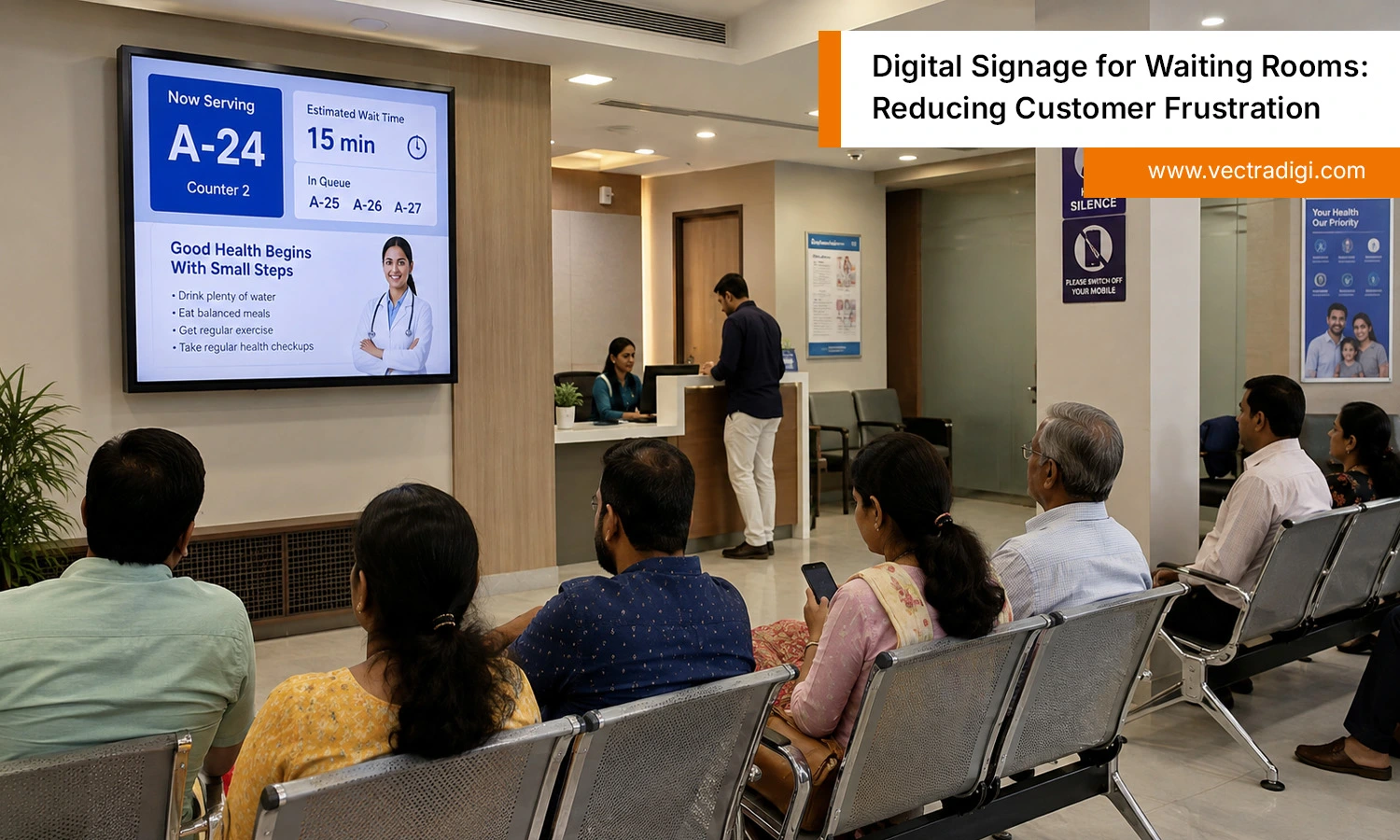
Picture this. You walk into a clinic, take a number, and sit down. There’s no clock in sight, no staff member making eye contact, and no update on how much longer you’ll be there. Minutes pass, and your patience runs out long before your name is called. That’s the thing about waiting rooms. The delay itself is not necessarily the main issue. It’s the silence around it. This is exactly where digital signage for waiting rooms earns its keep, turning a tense wait into a manageable one. In this post, we’ll look at why waiting rooms frustrate people and how digital signage fixes that.
Table of Contents
- Why Waiting Rooms Frustrate Customers in the First Place
- How Does Digital Signage Fit a Waiting Room?
- How Digital Signage Reduces Customer Frustration
- Practical Content Ideas for Waiting Room Screens
- Choosing the Right Digital Signage Solution
- Real Impact: What Businesses Notice After Switching
- Conclusion
- Frequently Asked Questions
Also Read: The Power of Signage in Retail: Boosting Sales with Visual Displays
Why Waiting Rooms Frustrate Customers in the First Place
Here’s something worth knowing: people don’t just react to how long they wait. They react to how long they think they’re waiting. Researchers call this “perceived wait time,” and it rarely matches the clock. A five-minute wait with no information can feel far longer than a fifteen-minute wait where you know exactly what’s happening.
The biggest culprit is silence. When nobody tells you what’s going on, your brain fills in the blanks, usually with worst-case assumptions. Did they forget about me? Is something wrong? Should I have said something at the front desk?
Think about the last time you sat in a bank lobby or a busy salon. If there was no screen, no announcement, no visible queue, chances are you kept glancing at the door or checking your phone every few minutes. That restlessness isn’t really about the wait. It’s about not knowing.
There’s also a compounding effect at play. Every unanswered question stacks on top of the last one, until a short delay starts to feel like an inconvenience worth complaining about. Businesses that ignore this pattern often end up with frustrated customers even when their actual service times are perfectly reasonable.
How Does Digital Signage Fit a Waiting Room?
Digital signage is simply any screen-based display used to share information, whether that’s a TV mounted on the wall, a tablet at the front desk, or an interactive kiosk near the entrance. Instead of static posters or handwritten whiteboards, these screens can update in real time and show whatever content a business needs at that moment.
Common Places You’ll See It
You’ve probably encountered digital signage more often than you realize:
- Medical and dental clinics showing patient queue numbers
- DMV and government offices displaying “now serving” updates
- Salons and spas running appointment schedules alongside beauty tips
- Banks and insurance offices sharing wait times next to promotional content
In each case, the screen does more than fill empty wall space. It gives people something to anchor their attention to while they wait.
How Digital Signage Reduces Customer Frustration
This is where the biggest benefits become clear. Digital signage doesn’t make the wait disappear, but it changes how that wait feels, and that matters more than most businesses realize.
Keeps People Informed in Real Time
The most obvious benefit is visibility. When a screen shows live queue numbers or an estimated wait time, customers stop guessing. They can relax a little, knowing where they stand and roughly when they’ll be seen. That one small shift, from uncertainty to clarity, does a lot of heavy lifting in customer satisfaction.
Makes Time Feel Shorter
There’s a reason airports play flight updates and grocery stores play music near checkout lines. Passive engagement, even something as simple as watching a slideshow of tips or local news, gives the brain something to focus on besides the clock. Waiting rooms with digital signage tend to feel less tedious, even when the actual wait time hasn’t changed at all.
Builds Trust Through Transparency
People are far more forgiving of delays when they feel informed. A screen that says “current wait: 20 minutes” builds more goodwill than a business that says nothing and hopes nobody notices the delay. Transparency signals respect for the customer’s time, even when that time is limited.
Reduces Front-Desk Pressure
Ask any receptionist what their most repeated question is, and you’ll likely hear some version of “how much longer?” Customers can use digital signage to get the information they need without repeatedly approaching employees. That means front-desk employees can spend more energy on actual service instead of fielding the same question every few minutes.
Adds Value Beyond Just Waiting
Beyond wait times, screens can share genuinely useful content: health tips in a clinic, seasonal promotions in a salon, or FAQs that save both the customer and staff some back-and-forth. Done well, the screen becomes part of the experience rather than just a distraction from it.
It’s a subtle shift, but it changes the emotional tone of the entire visit. Instead of feeling like they’re stuck waiting for something, customers feel like they’re being kept in the loop while a process plays out. That difference in framing is often what separates a five-star review from a lukewarm one.
Practical Content Ideas for Waiting Room Screens
If you’re setting up digital signage, the content matters as much as the hardware. A few ideas that tend to work well:
- Live queue status so customers always know where they stand
- Educational content relevant to your business, like appointment prep tips for a clinic
- Light entertainment, such as local news, weather, or simple trivia to pass the time
- Promotions or service highlights that customers might not otherwise notice
- On-screen FAQs that answer common questions before customers have to ask
The goal isn’t to overload the screen with information. It’s to keep it relevant, easy to glance at, and genuinely useful for someone who’s sitting there with a few spare minutes.
Choosing the Right Digital Signage Solution
Not all signage setups are created equal, and picking the right one depends on a few practical factors.
Ease of Use and Content Management
You want a system that your staff can update without needing a tech background. If updating a screen requires a call to IT every time, it’ll likely stay outdated and lose its usefulness fast.
Integration With Scheduling or Queue Systems
The best setups connect directly to your existing scheduling or queue management software, so wait times update automatically instead of relying on someone manually refreshing a number.
Screen Placement and Readability
A screen tucked in a corner or facing away from most seats won’t do much good. Placement should account for where people actually sit, how far they are from the screen, and whether the text and visuals are easy to read from a distance.
It’s also worth thinking about volume and pacing. If there’s audio involved, it should be subtle enough not to feel intrusive, and if content rotates automatically, it shouldn’t cycle so fast that people miss the information they actually came for, like their queue number.
Real Impact: What Businesses Notice After Switching
Businesses that add digital signage to their waiting areas tend to notice a shift pretty quickly. Front-desk complaints about wait times often drop, simply because customers already know what to expect. Online reviews sometimes start mentioning the “smooth” or “organized” feel of the visit, even when appointment times haven’t actually gotten faster.
It’s a small, practical change, but it tends to reshape how customers remember their visit. A wait that felt manageable and transparent leaves a very different impression than one that felt like being left in the dark.
Staff often notice the difference too. Fewer interruptions at the front desk means more time for the parts of the job that actually require a human touch, whether that’s checking someone in properly or answering a question a screen simply can’t.
Conclusion
At the end of the day, people don’t expect zero wait times. What they expect is to be treated like their time matters. Digital signage for waiting rooms does exactly that by replacing silence and guesswork with clear, real-time information. Customers stop wondering how much longer they’ll be sitting there, staff spend less time fielding the same question over and over, and the whole visit starts to feel more organized, even on a busy day. If your waiting area still relies on static posters or, worse, nothing at all, it might be time to rethink that empty wall space. A well-designed screen won’t just fill it. It’ll change how customers feel every single time they walk through your door, and that shift is often what keeps them coming back.
Ready to make your waiting room work smarter? Vectradigi helps businesses turn empty wall space into engaging, real-time digital signage that keeps customers informed and calm. Get in touch with Vectradigi today and see the difference for yourself.
Frequently Asked Questions
Q1. Does digital signage really reduce wait time complaints?
Ans: Yes, in most cases. Customers complain less about waiting when they know what’s happening and roughly how long it will take.
Q2. Is it expensive to install in a small business?
Ans: Not necessarily. Many solutions scale down to a single screen and a simple content management app, making them accessible for smaller waiting areas too.
Q3. Can one screen handle multiple types of content?
Ans: Absolutely. Most systems let you rotate between queue updates, promotions, and general content on the same screen without any extra hardware.