
Not so long ago, posters and billboards were the go-to way for businesses to get noticed. They’re still around, but to be honest, people probably don’t really look at them anymore. Think about the last time you walked through an airport, a shopping mall, or even your own office building. Did you pay attention to the posters on the wall? Probably not. What caught your eye were the glowing digital screens, flashing directions, offers, or maybe even a reminder to grab a coffee.
That’s where we are in 2025. Digital signage has quietly slipped into our everyday life, and half the time, we don’t even realize how much we rely on it. It’s not just about flashy screens anymore; it’s about solving real problems. From helping patients figure out where to go in a hospital to making sure students get safety alerts on time, digital signage is changing how we move, shop, and communicate.
So, let’s dig into five real-world applications that show how powerful it has become.
Table of Contents
Also Read: What is Digital Signage? Benefits, Uses, and Business Impact
Why Digital Signage is Important in 2025
People today don’t have the patience they once had. Attention spans are shrinking, and most of us take in visuals way faster than we ever read long text. That’s why posters on walls or static announcements barely get a glance anymore.
Digital signage is stepping in to fix that gap. It’s quick, it moves, and it feels alive. In 2025, it has become the most essential means of communication in busy places. Schools, airports, hospitals, and even corporate offices all rely on it because it reduces noise.
Think about it this way: instead of printing stacks of posters for one event, you just update a single screen. Instead of passengers freaking out over a missed announcement, they look up and see flight info changing in real time. That’s the real power of digital signage, it takes everyday communication problems and makes them manageable.
If you’re wondering what is Digital Signage with CMS, Read Our Full Guide Here.
1. Retail & Shopping Malls
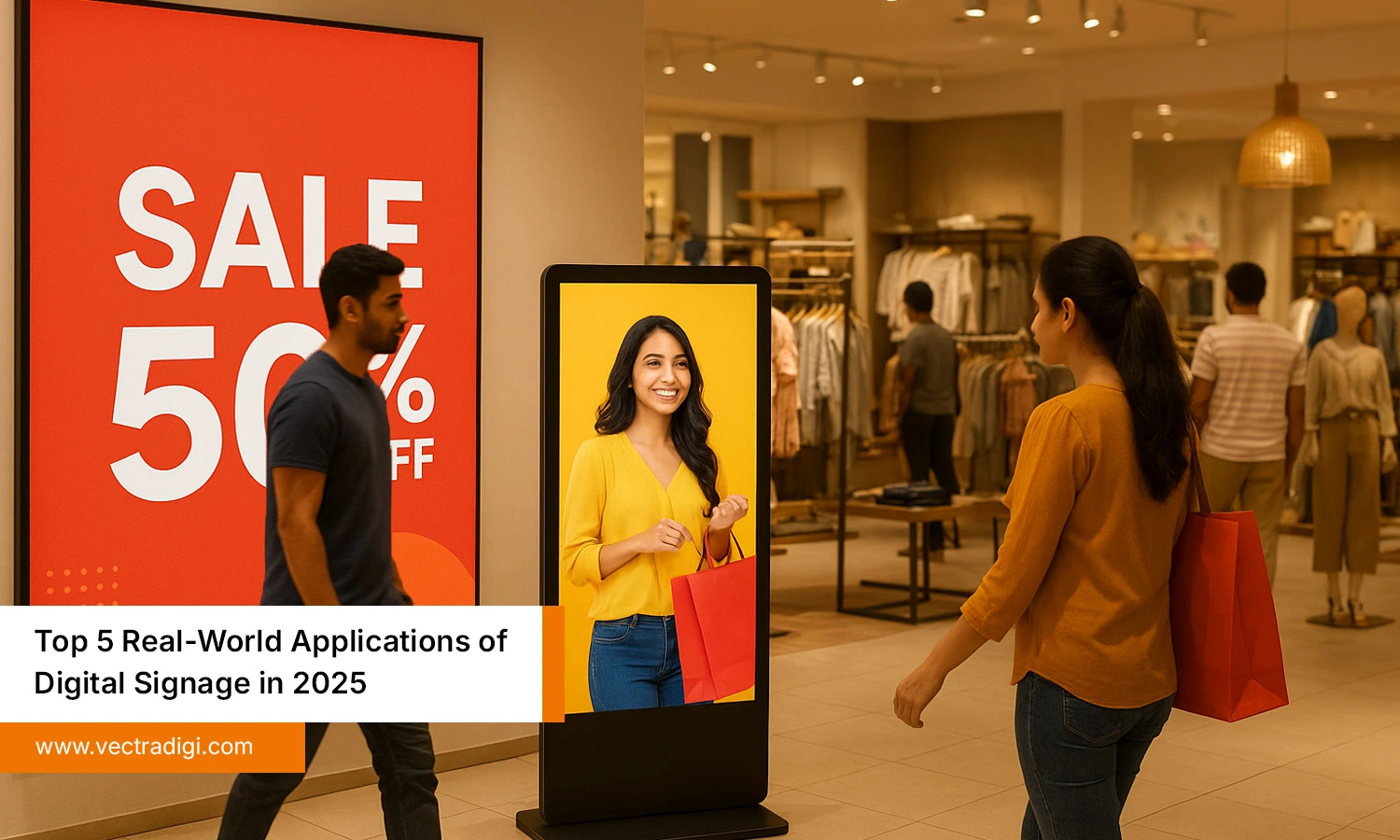
Imagine entering a crowded shopping center on a Saturday afternoon. It’s noisy, there are people everywhere, and frankly, no one knows where to start. Then your eyes fall on the screens. They’re displaying offers, showing you different sections, and pushing you toward deals. You’ll never know when you’ve stumbled upon the newest collection or the sale everyone’s talking about. It’s as if someone is guiding you without you even realizing it.
That’s what digital signage does for retail businesses. Stores get noticed even in the chaos, and shoppers don’t have to ask staff for directions or deals. Everything is right there, big and clear. Those old paper posters nobody looked at are basically history. Retailers save money, shoppers save time, and engagement just goes up.
Problem it solves: Shoppers wandering around confused, missing deals, and stores wasting money on posters nobody even notices.
2. Corporate Offices & Workplaces
In offices, digital signage can be used as a display where employees see the day’s meeting schedules, motivational messages, and updates on company achievements. It actually makes the space feel alive instead of just another dull room.
Digital signage in workplaces does more than decorate walls. In large companies, emails get buried, messages get missed, and people end up confused. But when reminders about meetings, birthdays, or safety instructions pop up on every screen around the office, people actually notice them. Before you know it, everyone knows what’s going on, and the whole place feels a lot more connected and open.
Problem it solves: Employees missing important messages and updates, leading to confusion and poor internal communication.
3. Healthcare & Hospitals
Hospitals are sometimes very stressful. Everyone’s running around, trying to figure out where to go. Then you notice the screens that show you exactly where the cardiology wing is, or the pharmacy, and honestly, it takes a bit of the panic away.
Digital signage in healthcare isn’t just nice to have. It actually helps. Emergency alerts pop up, appointment schedules, and even simple health tips in the waiting room. It all adds up to a calmer, safer place. That old mess of crowded reception desks and frustrated patients? Slowly disappearing, replaced by screens that actually guide people.
Problem it solves: Patients and visitors become confused or stressed because there is no clear guidance.
4. Airports & Transportation Hubs
Airports can be total chaos when information isn’t clear. Miss a single flight announcement, and you will find yourself scrambling. That’s where digital signage comes in. These large displays show flight times, gate changes, and security alerts right in front of passengers, so they don’t have to guess or rely solely on audio announcements.
The situation is the same at bus stations or metro centres. Live updates keep people moving and reduce confusion. Screens make everything just a little easier, a little calmer, and travelers don’t have to crowd around counters or ask staff every five minutes.
Problem it solves: Information overload. Travelers get updates instantly instead of panicking or crowding around counters.
5. Education & Universities
Walk through a campus and, well, the old notice boards are still there, but honestly, you probably notice the screens first. They show events, lecture changes, safety alerts—all in bright, easy-to-read displays. It’s just easier to catch stuff now.
Digital signage in schools and universities makes life less messy. You don’t have to go hunting for that tiny note on a corner board that no one really checks. And if something urgent happens, like a weather alert, the screens get the word out fast. Students and staff actually see it, instead of missing it because it was tucked away somewhere.
Problem it solves: Miscommunication and missed updates. People actually get the message instead of hoping they’ll notice some old paper on a wall.
Future Trends: Where Digital Signage is Heading
The future is actually pretty exciting. Screens are starting to get smarter, some can even suggest offers based on what people like, and touch screens let users poke around and find the info they want. Some even connect with mobile apps, which makes everything feel a bit more personal.
We’re really just scratching the surface here. It’s clear that digital signage isn’t going to stay one-way for long. Soon, it’s going to feel more like a conversation, not just a screen showing stuff.
Why Businesses Can’t Ignore It
Honestly, if a business is still relying only on posters or announcements stuck on walls, it’s already falling behind. Competitors are using screens to grab attention, update messages in real time, and save money on printing. Customers don’t want to wait or guess. They want things clear, fast, and simple. Digital signage makes that possible. Ignoring it doesn’t just slow you down, it can make your business invisible. Screens aren’t optional anymore. They’re part of how people expect to get information today.
Here’s what it does for businesses:
- Gets attention quickly in busy spaces
- Let’s you update messages immediately without extra cost
- Makes communication simple and easy to understand
- Improves engagement and reduces confusion
- Keeps your business visible and competitive
Conclusion
Digital signage has quietly become more than just screens, it’s a way to guide, inform, and connect people in real time. From retail to hospitals, offices to campuses, it’s solving real problems every day. The message is clear: businesses and institutions that embrace digital signage stay ahead, communicate better, and make life easier for everyone. Posters and static boards simply can’t keep up anymore. If you want your messages to matter, to reach people where they are, and to make an impact, digital signage isn’t optional—it’s essential.
Ready to make your business or campus easier to navigate and more engaging? Don’t wait, embrace digital signage today and start connecting with people in a way that actually works.