
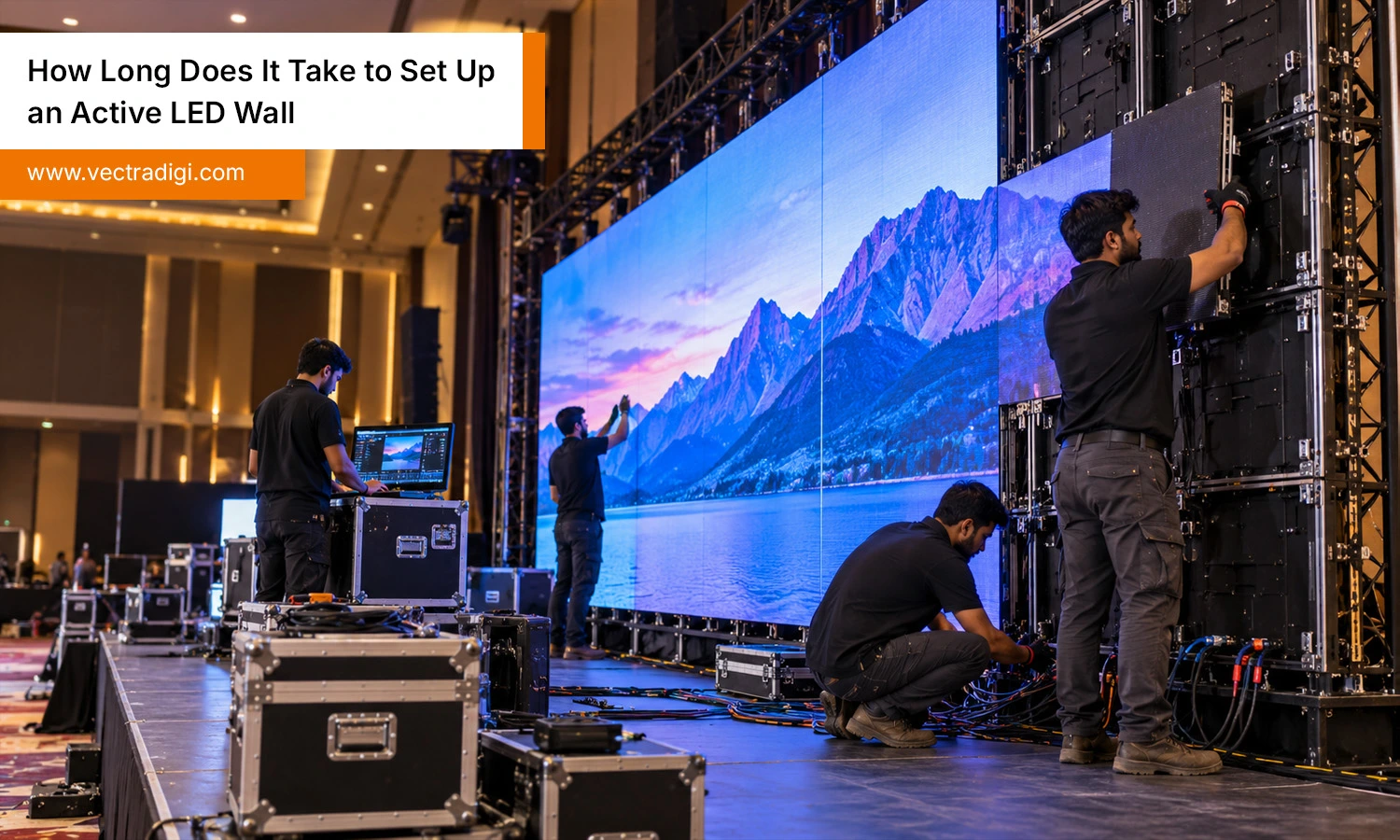
Ask ten event crews how long an LED install takes and you’ll hear ten different answers. Some say a couple of hours, others block out a full day, and both can be right. The real timeline depends on screen size, venue conditions, power supply, and how prepared your team is. If you’re planning a product launch, a concert, or a permanent lobby display, guessing wrong can wreck your schedule and budget. This guide walks through what actually happens when you set up an active LED wall, how long each stage takes, and what you can do to avoid painful delays on install day.
Also Read: How Long Does an Active LED Wall Really Last? Understanding Its Lifespan
The Short Answer: It Depends on Size and Site
Most small indoor setups take two to four hours. A medium stage backdrop usually needs half a day to a full day. Large concert or outdoor builds can stretch to two days or more, and permanent installations in lobbies, studios, or control rooms may run for a week or longer.
These numbers assume an experienced crew with all the equipment already on site. A basic active LED wall isn’t technically complicated, but it involves many small steps, and each one eats time when it’s rushed or skipped.
| Setup Type | Typical Size | Estimated Time |
|---|---|---|
| Small indoor booth or retail display | Up to 10 sq m | 2–4 hours |
| Event stage backdrop | 10–30 sq m | 4–8 hours |
| Large concert or outdoor screen | 30+ sq m | 1–2 days |
| Permanent installation | Varies | 3 days–2 weeks |
Where the Hours Actually Go
Knowing the stages helps you spot where a schedule can slip.
1. Site survey and planning
Good installers visit the venue first, or at least ask for photos and measurements. They check wall strength or floor space, ceiling height, door widths, elevator size, and power availability. This can take an hour or a couple of days of back-and-forth. It’s the cheapest time you’ll ever save, because most nasty surprises, like a doorway too narrow for flight cases, get caught here.
2. Structure and mounting
Before any panel goes up, the support has to be right. That might be a ground-stack base, a truss, a rigging grid, or a wall-mount frame. Ground-stacked screens go fastest. Flown screens need riggers, safety checks, and often motors, which adds hours. For permanent walls, the frame must be levelled almost to the millimetre, otherwise you’ll see ugly gaps between cabinets later.
3. Panel assembly
Cabinets lock together with quick-latches or bolts. A trained team can place a panel in a minute or two, but alignment is the slow part. Rows must sit flush, and every connection needs a firm click. For a mid-size screen, plan on one to three hours of pure assembly.
4. Power and data cabling
Every cabinet needs power and a signal line. Crews run power in balanced loops and daisy-chain the data cables. Labelling pays off here, since a messy cable run is the top reason a quick job turns into a long one when something fails. Also confirm the venue can supply enough amperage. An active LED wall pulls more power than most first-time buyers expect.
5. Processor setup, calibration, and testing
The video processor maps the screen, sets resolution and brightness, and manages colour. Calibration matters because panels from different batches can look slightly different side by side. After that, the crew runs test patterns, plays your actual content, and hunts for dead pixels or flickering modules. Give this stage one to three hours. Skipping it is how people end up with a screen that looks patchy in front of an audience.
What Slows an Install Down
Even a well-planned job can drift. These are the usual culprits:
- Tight access: stairs, narrow corridors, and slow lifts turn loading in into half the day.
- Power problems: unstable supply or too few circuits can force a redesign mid-install.
- Late content: wrong aspect ratios or low-resolution files mean last-minute edits while the crew waits.
- Weather: wind and rain can halt outdoor work completely.
- Inexperienced crew: a team new to LED may take twice as long and still miss something.
- Design changes: adding even one extra row of panels on the day can mean new cabling, new mapping, and a new power plan.
If your active LED wall is going outdoors, expect to add anywhere from half a day to a full day. You’ll need weatherproofing, wind-load checks, ballast or anchoring, and sometimes permits.
How to Speed Up Your Setup
You can’t control the weather, but you can control a lot else.
- Share measurements and photos early. A site visit beats assumptions every time.
- Prepare your content in advance. Ask the installer for the exact resolution and format, and send files before the day.
- Ask for a warehouse pre-test. A supplier who pre-builds and tests the active LED wall before shipping will save you serious time on site.
- Insist on labelled, pre-measured cables. It sounds boring, but it works.
- Hire experienced technicians. A good crew costs more per hour and often costs less overall.
- Add a 25% buffer. If you think it takes four hours, schedule five. Nobody has ever complained about finishing early.
- Do a short rehearsal. Run your presentation or show content once before guests arrive.
Conclusion
So, how long does it take? For most small indoor jobs, expect a few hours. Mid-size stage builds need most of a day, and large or permanent projects can take days.Is preparation more important than any single timeline estimate. A proper site visit, clear content specs, labelled cables, and an experienced crew will save you more time than any shortcut on the day. Plan realistically, add a buffer, and test early. Do that, and your active LED wall will be up, calibrated, and glowing well before the doors open, leaving you free to focus on the event itself instead of the wiring.
Contact our experts today to discuss your Active LED Wall requirements and get the right solution for your space, budget, and goals.
Frequently Asked Questions
Q1. Can one person set up a small LED screen in one day?
Ans: Yes, a small screen is manageable, but you’ll want a helper for lifting and alignment. Read the manual first, test every panel beforehand, and avoid rigging overhead without professional support.
Q2. Why did our LED wall installation take longer than the quoted time?
Ans: Usually its site issues nobody checked earlier, such as limited power, tight access, late content files, or weather. A proper survey and buffer hours prevent most of them.
Q3. Does an outdoor LED screen take much longer to install than indoor?
Ans: Typically yes. Outdoor builds need weatherproofing, wind-load checks, ballast or anchoring, and sometimes permits, which can add half a day to a full day depending on size and location.
Q4. How early should I book installers before my event starts?
Ans: Book at least two to three weeks ahead for events, longer for permanent installs. That leaves room for a site visit, content preparation, and a full test before the actual day.

