Walk into most factories today, and you’ll still see the same thing — printed sheets pinned to a corkboard, a whiteboard someone half-erased, and a shift manager shouting over machine noise to pass on a production update. It barely works. But in an industry where every minute of downtime costs money, and every miscommunication can become a safety incident, barely working isn’t good enough anymore. That’s exactly where digital signage for manufacturing steps in, and it’s changing things faster than most plant managers expected.
According to a report by MarketsandMarkets, the global digital signage market is projected to reach $29.6 billion by 2026. Manufacturing is one of the fastest-growing sectors adopting this technology, and it’s not hard to see why. Smart screens are doing what cork boards never could, such as delivering the right information to the right people, at exactly the right moment.
Table of Contents
Also Read: How Digital Signage in Hospitals Enhances Patient Experience and Communication?
What Is Digital Signage for Manufacturing?
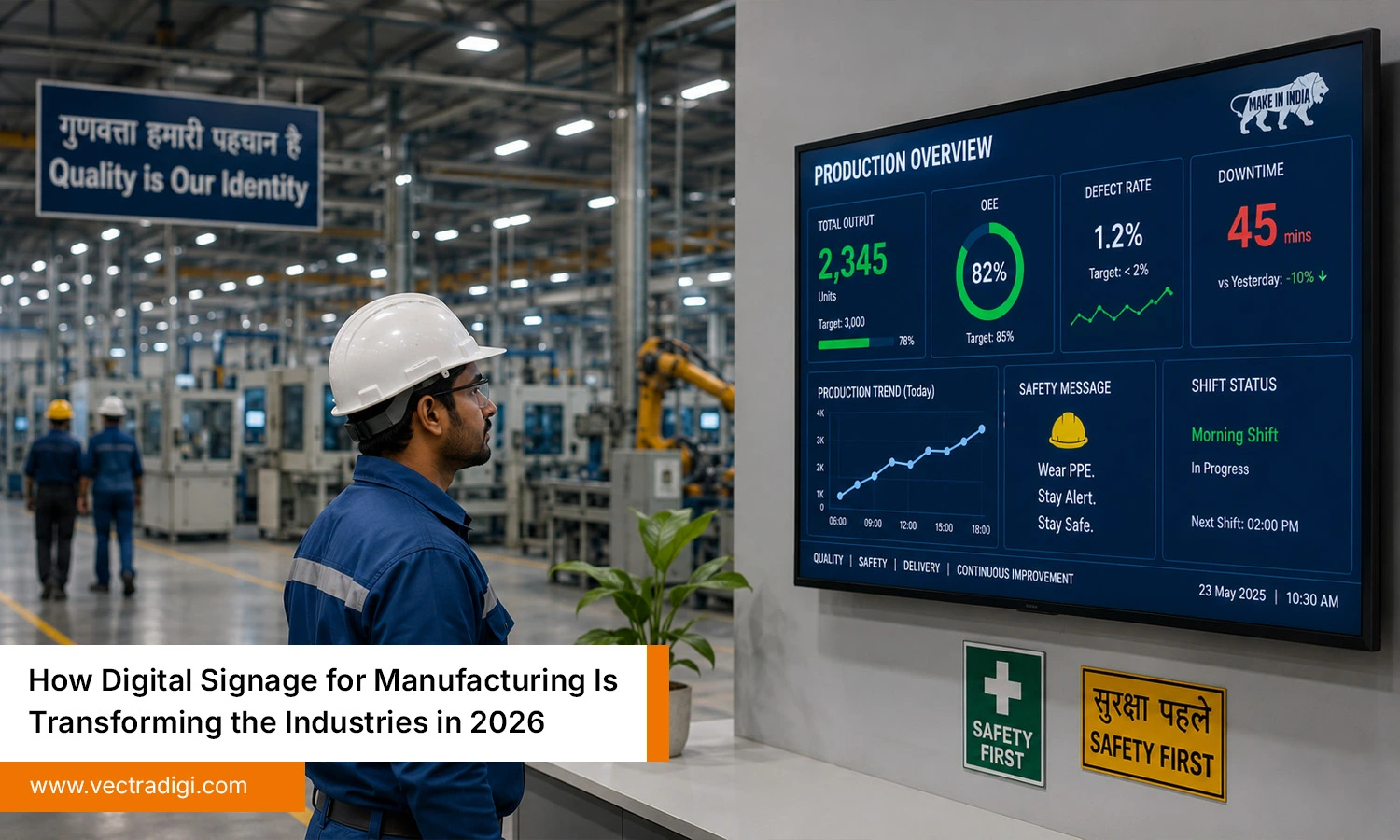
Before moving ahead, let’s make this point clear. Digital signage for manufacturing isn’t just about replacing a printed sign with a screen. It functions as a complete communication network that brings together production insights, safety information, shift notifications, and performance tracking into a real-time visual system employees can easily view and understand. Think of it as your factory’s central nervous system being visible.
This includes industrial-grade display screens mounted on the shop floor, KPI dashboards showing live output numbers, safety alert boards that update instantly, digital notice boards for shift handovers, and visual management screens tied directly to your ERP or MES software.
Unlike traditional signage, these screens don’t go stale. They pull in real-time data, update automatically, and can be managed remotely from a single dashboard across an entire facility or even multiple plants. For manufacturers managing complex operations and narrow profit margins, that level of visibility is no longer considered a luxury. It’s a competitive advantage.
Main Advantages of Using Digital Signage in Manufacturing Facilities
This is where things get genuinely exciting. The influence of digital signage for manufacturing goes beyond daily operations, affecting workplace safety, company culture, productivity, and employee confidence as well. Here’s what manufacturers are actually experiencing.
1. Real-Time Production Monitoring
A major challenge in manufacturing is the disconnect between real-time shop floor operations and management’s understanding of those activities. Production monitoring screens close that gap completely.
When output numbers, cycle times, and defect rates are displayed live on large screens above the line, workers and supervisors don’t have to wait for an end-of-shift report to know things are going wrong. They see it happening, and they fix it faster. Some plants report a 15–20% improvement in OEE (Overall Equipment Effectiveness) simply by making real-time data visible.
2. Improved Worker Safety
Safety briefings printed on paper get ignored. A flashing alert on a 55-inch screen at eye level? Much harder to miss. Digital safety signage lets facilities push instant alerts for equipment faults, hazardous conditions, or procedural changes. It can display daily safety scores, near-miss counters, and compliance reminders, all updated automatically. This isn’t just good for workers. It’s good for audits, too.
3. Reduced Downtime Through Faster Communication
When a machine goes down, every second matters. In a traditional setup, the information travels slowly, operator tells supervisor, supervisor calls maintenance, maintenance finds the right person. Meanwhile, the line sits idle.
With industrial digital signage integrated into your maintenance system, a fault triggers an instant visual alert on screens nearest to the issue. The right people see it immediately. Response times drop. And so does unplanned downtime.
4. Better Shift Handover Communication
Any operations manager will admit that shift handovers are among the most critical and vulnerable periods within a manufacturing plant. Information gets lost, context disappears, and the incoming team starts from scratch.
Digital shift communication boards change that. The outgoing shift leaves a live visual summary, targets hit, issues flagged, machines to watch and the incoming team walks in already informed. No confusion or mixed messages, only a transparent view of the current situation.
5. Energy and Compliance Tracking
An increasing number of manufacturers are facing pressure to achieve sustainability goals while maintaining compliance with environmental regulations. Intelligent display screens can showcase real-time energy usage, emissions monitoring, and compliance metrics, ensuring the entire workforce stays informed and responsible rather than limiting visibility to office staff alone.
Real-World Use Cases That Show the Difference
Automotive Assembly Line:
Imagine a mid-sized automotive parts plant struggling with inconsistent line speeds and too many quality escapes reaching the end of the line. After installing real-time production monitoring screens at each station, workers could see their own output pace against the daily target live. Supervisors no longer needed to physically walk the line every hour to check progress. Quality defects caught early increased by 30% within the first quarter, simply because people had the data they needed, right in front of them, when it mattered.
Food and Beverage Plant:
A food processing facility dealing with strict hygiene compliance and daily temperature regulation had a persistent problem: paper-based checklists were being completed inconsistently, and audit trails were a nightmare to manage. They switched from traditional manual boards to digital compliance displays that refreshed automatically every 15 minutes by collecting temperature readings directly from connected sensors. As a result, compliance performance improved, audit preparation took far less time, and workers gained greater confidence since the requirements at each workstation were communicated clearly.
Electronics Production Facility:
In an electronics plant handling high-mix, low-volume operations, communication between shifts was highly disorganized. Different product lines, different build sequences, and a workforce spread across three floors made it nearly impossible to keep everyone aligned. Implementing digital notice boards with production schedules tailored to each shift and refreshed during every handover significantly reduced communication errors and enabled new employees to adapt much more quickly.
Each of these scenarios is different. But the thread running through all of them is the same: the right information, visible to the right people, at the right time.
How to Choose the Right Digital Signage System for Your Facility
Not all digital signage solutions are built for the factory floor. Picking the wrong system is an expensive lesson. Here’s what to actually look for.
Screen durability matters more than you think. Factory environments are harsh dust, vibration, humidity, and extreme temperatures. Look for screens with industrial IP ratings (IP54 or higher) that can handle your specific environment. A screen designed for a shopping mall will not survive on a production floor.
Integration is non-negotiable. Your digital signage for manufacturing should connect to your existing ERP, MES, or SCADA systems. If it can’t pull live data automatically, you’re just paying a lot of money for a very expensive printed sign.
Content management needs to be simple. If updating the screens requires an IT ticket every time, it won’t get done. Look for a CMS that lets floor supervisors make quick changes themselves without technical training.
Think about scalability from day one. You might start with one plant, but if it works, you’ll want to roll it out across more sites. Choose a platform that can scale without a complete overhaul.
Don’t ignore after-sales support. Hardware fails and software has bugs. If a system fails during a 2 a.m. night shift, there should be a clear point of contact ready to handle the issue. Make sure your vendor has solid support infrastructure before you sign anything.
Common Mistakes Manufacturers Make (And How to Avoid Them)
Plenty of manufacturers invest in digital signage and see disappointing results. In most cases, the issue can be traced back to one of these preventable errors.
Putting screens in the wrong places. A display that employees cannot easily view during their work serves no practical purpose. Display placement should be planned according to actual movement patterns and visibility across the factory floor, rather than simply choosing spots close to available power sources.
Overloading screens with too much information. More data doesn’t mean better visibility. When a display tries to present too many metrics simultaneously, employees are likely to ignore it after a short period of time. Each screen should have a clear, focused purpose. Keep it simple. Keep it scannable.
Letting content go stale. A digital screen showing last month’s safety target is arguably worse than no screen at all, it signals that nobody’s paying attention. Set a content review schedule and stick to it. This is usually a people process problem, not a technology one.
Skipping worker feedback. The people standing in front of these screens all day know better than anyone whether they’re actually helping. Involve floor workers in the design and placement decisions early. You’ll get better outcomes and far less resistance to the change.
Conclusion
Digital signage for manufacturing is no longer something you pilot in one corner of the plant and forget about. It’s becoming the backbone of how modern factories communicate, operate, and compete. From real-time production data to safety alerts and shift handovers, smart screens are solving problems that clipboards and whiteboards never could. The technology is accessible, the ROI is measurable, and the factories already using it are pulling ahead. If your facility is still running on outdated communication methods, the question isn’t whether to make the switch but it’s how much longer you can afford not to.
Ready to explore digital signage solutions built for industrial environments? Talk to a specialist or explore our related guides on factory floor communication and lean manufacturing tools.
Frequently Asked Questions
Q1. What is digital signage used for in manufacturing?
It provides live production insights, safety notifications, KPI metrics, and shift-related information directly across the factory floor.
Q2. How does digital signage improve factory floor safety?
It pushes live safety alerts, equipment warnings, and compliance reminders instantly by making critical information visible and impossible to overlook.
Q3. Is digital signage worth the investment for small and mid-sized manufacturers?
Absolutely. It reduces downtime, improves communication, and delivers measurable ROI — even for single-plant, mid-sized manufacturing operations.