Advertising has always been about getting noticed, but today that goal feels harder than ever. People are constantly surrounded by messages, offers, and visuals competing for their attention. Posters fade into the background, banners are ignored, and flyers often go unread, creating a real challenge for brands trying to stay visible. This is where the discussion around digital signage vs traditional advertising begins. Businesses are no longer asking only how to advertise, but where and in what form. In this blog, we’ll compare both approaches, explore their key differences, costs, and impact, and help you understand which option makes more sense for modern brands today.
Table of Contents
Also Read: Top 6 Benefits of Digital Signage for Modern Businesses
Why Advertising Methods Matter More Than Ever Today
Attention spans are shorter than ever, and people move through information quickly, stopping only when something truly stands out. In such a crowded advertising environment, the method you use to communicate your message matters just as much as the message itself. Traditional advertising once worked because there was less noise, allowing posters and hoardings to stand out naturally. Today, those same formats are surrounded by similar visuals and often get ignored. Modern advertising focuses on visibility, timing, and relevance, requiring formats that can adapt and respond in real time. Choosing the right advertising method is critical because:
- Attention spans are shrinking.
- Competition for visibility is higher than ever.
- Audiences expect dynamic and engaging content.
- Relevance and timing influence recall.
- The right medium improves brand impact and ROI.
Digital Signage vs Traditional Advertising: Core Differences
1. Visibility and Attention-Grabbing Power
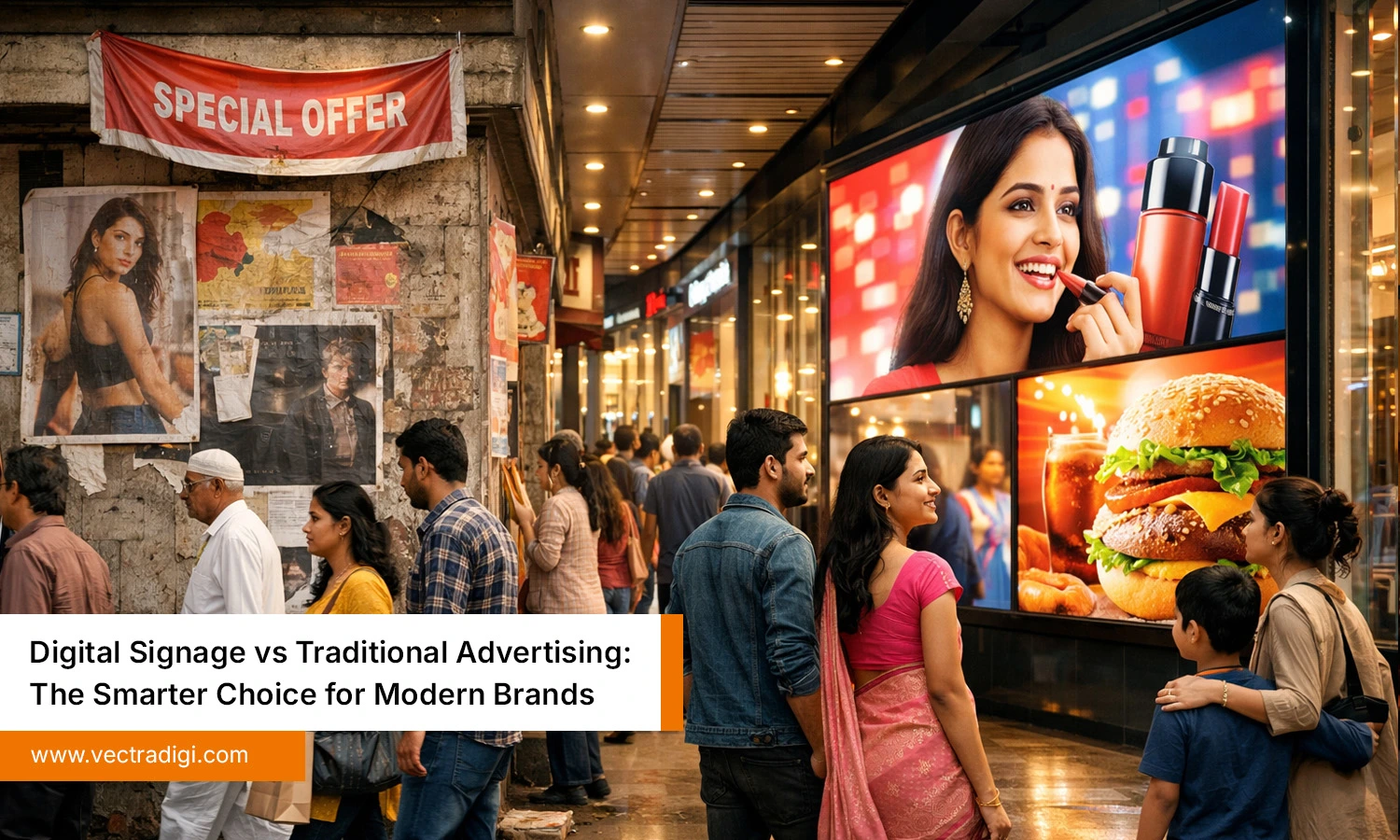
Human eyes are naturally attracted to movement, brightness, and change. In busy environments, static visuals struggle to compete, no matter how well they are designed. A printed poster may catch attention once, but after that, it simply blends into the background. Digital screens, however, stand out without effort. Their light, motion, and dynamic content naturally pull people in. In busy spaces such as malls, retail outlets, airports, and offices, digital screens naturally stand out and feel more engaging. This immediate visibility gives brands a strong advantage in spaces where attention is limited and every second truly matters.
2. Cost Over Time and Practical Value
At first glance, traditional advertising appears cheaper. Printing a few posters or banners feels like a small expense. However, over time, repeated printing, installation, and replacement add up quietly. Seasonal campaigns, expired offers, and worn-out materials increase ongoing costs. Digital signage shifts spending toward long-term value. While the initial setup may be higher, the same screens can be reused for years. Brands save money by running unlimited campaigns without printing again, making digital signage a more practical and cost-effective advertising option in the long run.
3. Content Flexibility and Control
Once a traditional ad is printed, that’s it. It’s done. If the price changes or an offer ends early, you can’t really fix it without starting all over again. New design, new print, new installation. That takes time, and it costs money, every single time. Digital signage doesn’t work like that. Content can be changed whenever needed, even on the same day. Brands can schedule messages, switch content by location, or pause something that no longer makes sense. That kind of control helps businesses stay relevant and avoids the awkward situation of showing outdated or incorrect information.
4. Engagement and Message Recall
People don’t usually remember still images for long. What stays with them are experiences. Movement, animation, and short visual stories tend to create a stronger emotional pull than static ads ever can. Most printed advertisements get a quick glance and are forgotten moments later. Digital displays work differently. They let brands show products in action, play with emotions, and share a message in just a few seconds. That movement helps the message stick. And when people remember what they’ve seen, they’re more likely to trust the brand and act on it later.
5. Speed of Communication
Timing matters more than most brands realize. A message that arrives late usually doesn’t work at all. With traditional advertising, even a small update can take days, sometimes longer, because designs need changes, prints need approval, and installation takes time. By then, the moment has often passed. Digital signage removes the waiting. Content can be changed in minutes, sometimes instantly. This makes it easier to react to offers, events, or sudden changes. When comparing digital signage vs traditional advertising, this ability to move fast often becomes the deciding factor.
Cost Reality: Short-Term Savings vs Long-Term Returns
Many businesses look first at upfront cost, and that makes sense. Traditional advertising feels familiar and safe, mostly because it looks cheaper at the start. But that thinking often skips what happens later. Printed ads wear out, offers expire, and designs stop feeling fresh. Every small change means printing again, fixing placements, and paying again. Over time, those small costs pile up. Digital signage works differently, and one screen can be reused again and again for new campaigns. Brands that track performance usually notice better visibility and stronger engagement. When ROI is viewed long-term, digital formats tend to make more sense.
Where Traditional Advertising Still Makes Sense
Traditional advertising still works sometimes. I’ve seen it myself. For a local shop or a quick announcement, posters and banners can still do enough. They’re simple, familiar, and don’t require much thinking. For new brands, that alone feels reassuring. But problems show up when brands stick to it for too long. Results slow down. Visibility drops. Growth feels stuck. On its own, it rarely takes a brand very far. Used alongside digital formats, though, it can still help. The key is knowing where it fits, instead of expecting it to do everything.
Why More Modern Brands Are Choosing Digital Signage
Modern brands are choosing digital signage because it simply fits the way businesses work today. Consistency matters, but so does speed, and digital displays make it easier to manage both. The same message can appear across different locations while still being adjusted for timing, audience, or even mood. As brands grow, their communication needs naturally become more complex. Digital signage grows with them instead of holding them back. Screens don’t need to be replaced every time a strategy shifts. That’s why many brands are moving toward screen-based communication, not because it’s trendy, but because it matches how people actually notice, read, and absorb information today.
Conclusion
Choosing between digital signage and traditional advertising is no longer just a budget decision, it’s a visibility decision. Traditional methods still have value in specific situations, but their limits become clear in a fast-moving, attention-driven world. Digital signage offers flexibility, speed, stronger engagement, and better long-term returns, helping brands stay relevant instead of static. As customer behavior continues to shift toward screens and dynamic content, advertising methods must evolve too. The smartest brands aren’t abandoning traditional formats completely, they’re adapting by understanding where each approach fits. Businesses can create advertising strategies that are practical, modern, and built for sustained growth.
Ready to upgrade how your brand communicates? Discover smarter digital signage solutions with Vectradigi and turn attention into action with displays designed for modern, high-impact advertising.